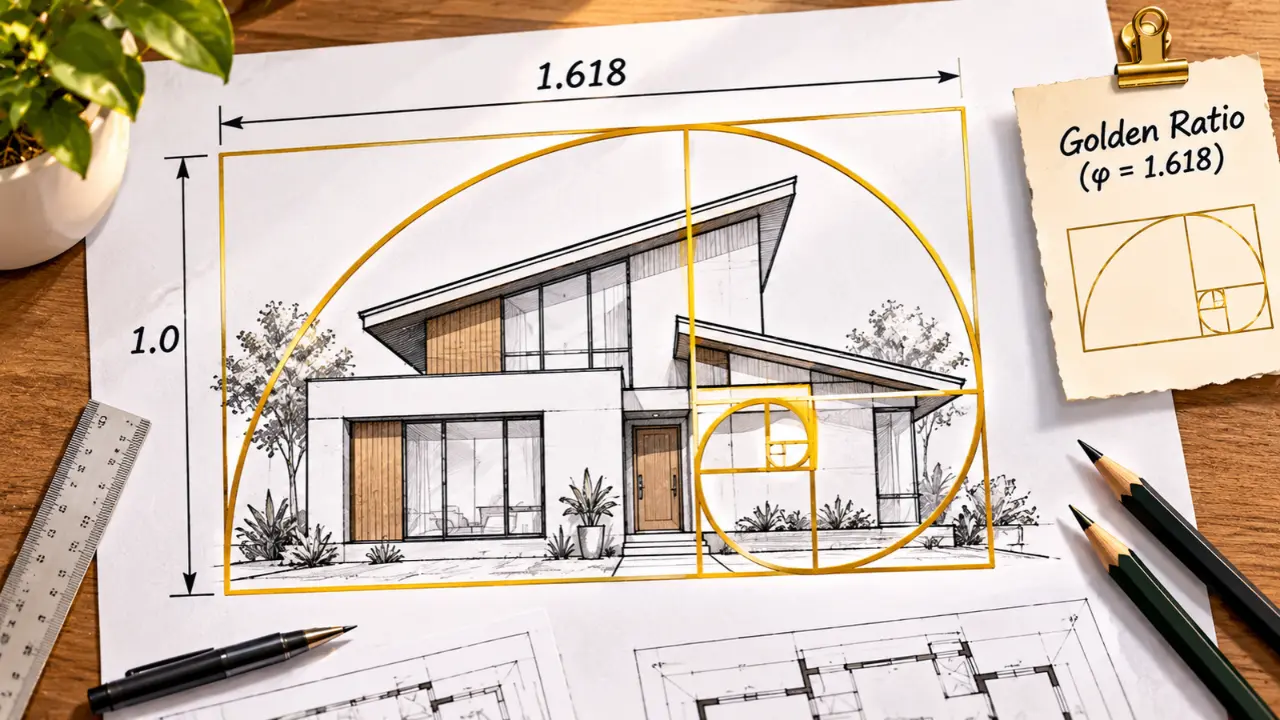
Ever wondered why some drawings feel instantly balanced and pleasing to look at, while others seem slightly “off”? Often, the secret is in the proportions. The golden ratio is one of the most famous tools artists and designers use to create harmony in their work. The good news is you don’t need to be a maths expert to use it. Here’s a simple guide to applying the golden ratio to your 2D sketches.
What Is the Golden Ratio?
The golden ratio is a special number, roughly 1.618, often written with the Greek letter phi (φ).
It describes a relationship where a line is divided into two parts so that the whole line compared to the longer part equals the longer part compared to the shorter part.
In simple terms, if the shorter part is 1, the longer part is about 1.618. This proportion tends to look naturally balanced to the human eye.
It’s closely linked to the Fibonacci sequence: 1, 1, 2, 3, 5, 8, 13, 21 and so on, where each number is the sum of the two before it. Divide any number by the one before it, and the result gets closer and closer to 1.618.
Why Artists Use It
The golden ratio appears in some natural patterns, such as the arrangement of sunflower seeds, pinecones and some shells.
Many artists and designers use it to guide composition, because it helps place shapes and focal points in a way that feels pleasing rather than random.
You’ll often hear claims that famous works like the Parthenon or the Mona Lisa were built on the golden ratio. Historians still debate many of these claims, so it’s best to treat the golden ratio as a helpful guide, not a magic formula.
The Golden Rectangle and Spiral
Two shapes make the golden ratio easy to use in sketching.
The golden rectangle has sides in the ratio of about 1:1.618. If you cut a perfect square from one end, the leftover piece is another, smaller golden rectangle. You can repeat this again and again.
The golden spiral is drawn by connecting curves through those squares. It creates a smooth, flowing spiral that leads the eye towards one point.
Artists often place the most important part of the drawing, such as a face, a flower or a building, near the tight centre of the spiral.
How to Use the Golden Ratio in Your Sketch
Here’s a simple way to start:
- Set your canvas size. Try a sheet with sides in a 1:1.618 ratio, for example 10 cm by about 16.2 cm.
- Draw a phi grid. Divide the page into three sections both ways, using proportions of roughly 1 : 0.618 : 1. This creates lines slightly closer to the centre than a standard thirds grid.
- Place your focal point. Put your main subject where the grid lines cross, or at the centre of a golden spiral overlay.
- Balance your shapes. Size large and small elements using the 1:1.618 ratio. For example, if a tree is 8 cm tall, a nearby bush might be about 5 cm.
- Guide the eye. Use the spiral’s curve to place lines, paths or gestures that lead viewers towards your focal point.
Tip: Lightly sketch your grid or spiral in pencil, then erase it once your composition is set.
Golden Ratio vs. the Rule of Thirds
The rule of thirds is a simpler cousin of the golden ratio. It divides the page into three equal parts both ways, creating nine boxes.
The golden ratio grid works the same way, but the lines sit closer to the centre. This often creates a slightly tighter, more natural balance.
If you’re a beginner, start with the rule of thirds. Once you’re comfortable, try switching to the phi grid to see the difference.
Common Mistakes to Avoid
Don’t force every element to fit the ratio perfectly. Art still needs feeling and creativity, not just measurements.
Avoid placing your main subject exactly in the centre of the page if you want a more dynamic look. Off-centre placement usually feels more interesting.
And don’t skip practice. The more you use the golden ratio, the more naturally you’ll start to see balanced proportions without measuring.
Frequently Asked Questions
What is the golden ratio number?
It’s about 1.618, often called phi (φ).
Do I need maths to use the golden ratio in drawing?
No. Simple tools like a phi grid or a golden spiral overlay make it easy to apply visually.
Is the golden ratio better than the rule of thirds?
Neither is “better”. The rule of thirds is simpler, while the golden ratio offers slightly more refined balance.
Can I use the golden ratio in digital art?
Yes. Many drawing and design apps let you add golden ratio grids or spiral overlays to guide your composition.