

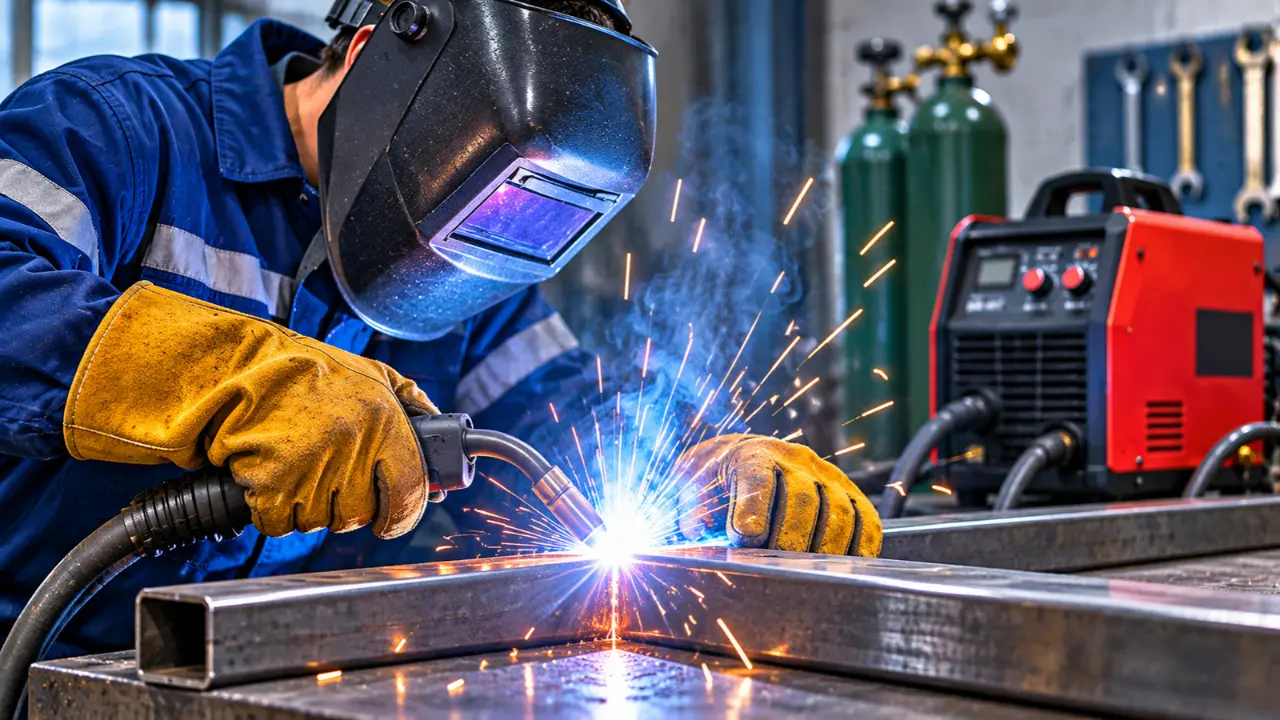
Welding is how metal parts are joined together, from car frames and bridges to garden gates and kitchen equipment. But there isn’t just one way to weld. Different metal welding systems suit different jobs, materials and skill levels. Here’s a clear guide to the most frequently used welding methods, how they work and when to use each one.
What Is Metal Welding?
Welding joins two pieces of metal by heating them until they melt and fuse together. A filler material is often added to strengthen the joint.
Once the metal cools, the two pieces become one solid part. Done well, a welded joint can be as strong as, or stronger than, the metal around it.
The main difference between welding systems is how they create heat and how they protect the hot metal from air, which can weaken the weld.
MIG Welding (Gas Metal Arc Welding)
MIG welding is one of the most popular methods, especially for beginners.
A welding gun feeds a continuous wire into the joint, while a shielding gas protects the weld from contamination. You simply pull the trigger and guide the gun.
Best for: Steel, stainless steel and aluminium, especially thin to medium sheets.
Why people like it: It’s fast, fairly easy to learn and produces clean welds. That’s why it’s common in car repair, fabrication shops and home workshops.
Downside: The shielding gas can blow away in windy conditions, so it works best indoors.
TIG Welding (Gas Tungsten Arc Welding)
TIG welding uses a non-consumable tungsten electrode to create the arc. The welder adds filler rod by hand with one hand while controlling the torch with the other.
Best for: Thin metals, stainless steel, aluminium and jobs where appearance matters.
Why people like it: It gives precise, neat and very strong welds. It’s widely used in aerospace, food-grade stainless steel equipment and custom bike or car parts.
Downside: It’s slower and harder to learn, as it needs steady hands and good coordination.
Stick Welding (Shielded Metal Arc Welding)
Stick welding is one of the oldest and most versatile methods. It uses a metal rod (the “stick”) coated in flux. As the rod melts, the flux creates a protective gas and a layer of slag over the weld.
Best for: Thick steel, outdoor jobs, repairs and construction work.
Why people like it: The equipment is simple, affordable and portable. It also works well outdoors and on rusty or dirty metal.
Downside: It creates more spatter, and you need to chip off the slag after welding. It’s less suited to very thin metal.
Flux-Cored Arc Welding
Flux-cored welding works much like MIG, but the wire has flux inside it. Some types don’t need an external gas at all.
Best for: Thick materials, outdoor work and heavy construction.
Why people like it: It’s fast, penetrates deep into thick metal and handles wind better than standard MIG.
Downside: It produces more smoke and slag, so welds need cleaning afterwards.
Other Welding Systems Worth Knowing
Oxy-acetylene (gas) welding uses a flame from burning gas rather than electricity. It’s portable and also used for cutting and heating metal, though it’s slower than arc welding.
Spot (resistance) welding joins overlapping metal sheets by passing an electric current through them under pressure. It’s widely used in car manufacturing.
Laser welding uses a focused laser beam for fast, precise welds. It’s mostly found in high-tech manufacturing due to its cost.
Common Welding Systems Compared
| Welding Type | Skill Level | Best Metals | Best Use | Works Outdoors? |
|---|---|---|---|---|
| MIG | Beginner-friendly | Steel, stainless, aluminium | Fabrication, car repair | Limited |
| TIG | Advanced | Stainless, aluminium, thin metals | Precision and clean finishes | Limited |
| Stick | Moderate | Thick steel, iron | Construction, repairs | Yes |
| Flux-cored | Beginner to moderate | Thick steel | Heavy and outdoor work | Yes |
| Oxy-acetylene | Moderate | Steel, some non-ferrous metals | Repairs, cutting, heating | Yes |
| Spot | Machine-based | Sheet metal | Mass production | Factory use |
How to Choose the Right Welding System
Think about three things: the metal, its thickness and where you’ll be working.
- New to welding? Start with MIG or flux-cored.
- Working outdoors or on thick steel? Stick or flux-cored is a solid choice.
- Need neat, precise welds on thin metal? TIG is the best option.
- Doing light repairs and cutting? Oxy-acetylene can be handy.
Welding Safety Basics
Whatever method you use, safety comes first.
Always wear a proper welding helmet with the correct shade, flame-resistant clothing, gloves and safety boots. Work in a well-ventilated area, because welding fumes can be harmful.
Keep flammable materials away from your work area, and keep a fire extinguisher nearby.
Frequently Asked Questions
What is the most commonly used welding method?
MIG welding is one of the most widely used methods because it’s fast, versatile and easy to learn.
Which welding type is easiest for beginners?
MIG and flux-cored welding are generally the easiest to pick up.
Which welding method is strongest?
Any method can produce a strong weld when done correctly. TIG is known for very high-quality, precise welds.
Can I weld outdoors?
Yes. Stick and flux-cored welding work best outdoors, as they don’t rely on shielding gas that wind can blow away.